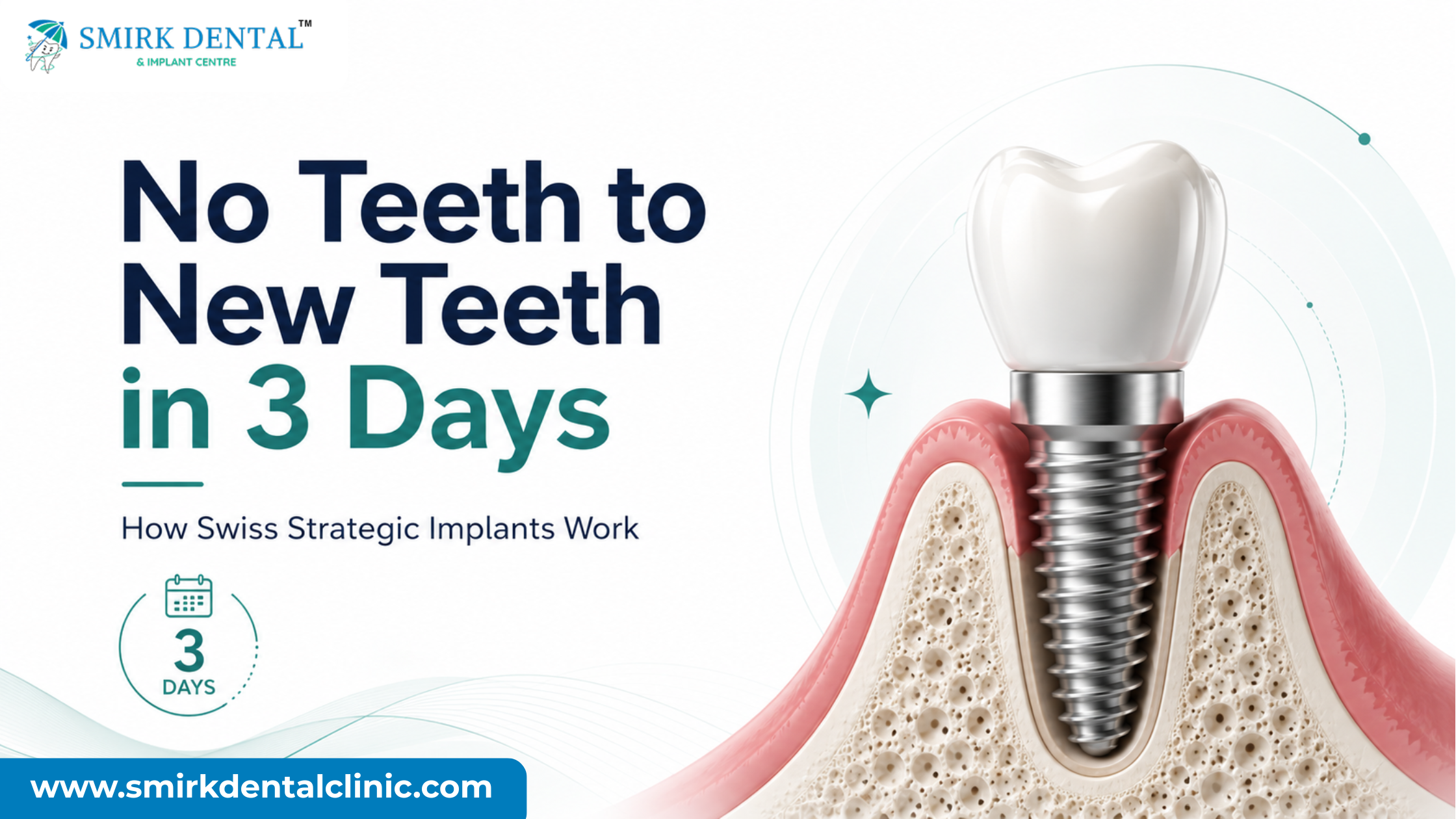
Ask anyone who has lived with missing teeth for a while, and the gap itself is rarely what bothers them most. It’s what stops working around it – chewing carefully on one side, avoiding photos mid-laugh, putting off a cousin’s wedding invitation because three months of temporary dentures feels like too much to manage. At Smirk Dental & Implant Centre in Laxmi Nagar, Dr. Kapil Gupta built his implant practice around solving that exact problem, and doing it fast. His approach uses Swiss Strategic Implants with immediate loading, a protocol that takes a patient from missing teeth to new teeth in 3 days – not three months, not a season.
Dr. Gupta graduated from Maulana Azad Institute of Dental Sciences (MAMC), one of Delhi’s most demanding dental programs, and completed his Master’s in Prosthodontics – the super-specialty focused on replacing missing teeth – before earning his certification in Immediate Loading Dental Implants from the International Foundation in Munich, Germany. He was among the first clinicians in India to bring the technique home, and after more than a decade of successfully placing these implants and treating more than 10,000 patients overall, it’s still the anchor of how Smirk Dental treats missing teeth.
What “Immediate Loading” Actually Means
Traditional implants follow a two-stage process for good biological reasons. The implant goes into the jawbone, and then the patient waits, usually three to six months, while the bone fuses to the titanium post through a process called osseointegration. Only once that fusion is confirmed does the permanent crown or bridge go on top. In the meantime, patients typically wear a removable temporary, which is part of why so many people put off treatment for years.
Immediate loading changes the sequence, not the biology – and the Swiss Strategic Implant technique changes what’s possible within that sequence too. Even when a patient doesn’t have enough bone for a conventional implant, this technique can achieve strong initial stability by anchoring into denser, more stable bone structure, working on the same osseofixation principle used in orthopaedic fracture fixation rather than depending on standard bone volume the way traditional implants do. That’s part of why a functional prosthesis can be delivered within days for patients a conventional implant would otherwise rule out. A recent umbrella review pooling multiple systematic reviews on implant loading protocols found that immediate and non-immediate loading produced comparable long-term survival rates, generally in the 92–98% range, and noted that careful case selection is what makes the immediate approach reliable. That case-by-case judgment is exactly where Dr. Gupta’s clinical experience matters more than the technology itself.
The 3-Day Timeline, Day by Day
| Day | What Happens |
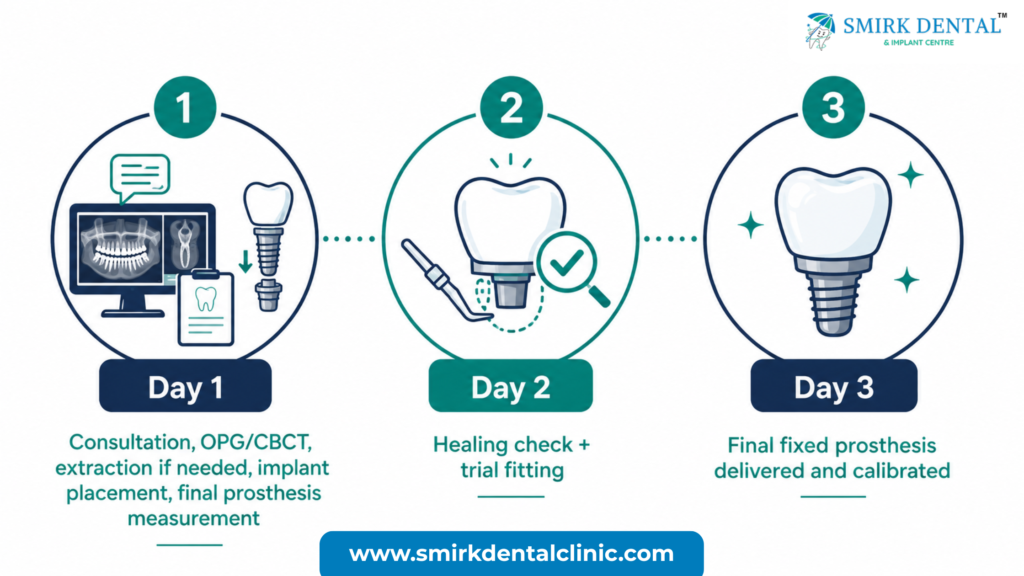
| Day 1 | Initial consultation, X-rays and digital scans (OPG/CBCT), extraction if required, implant placement, and precise measurement for the final prosthesis. |
| Day 2 | Healing check and a trial fitting of the prosthesis to confirm bite and fit. |
| Day 3 | Final fixed prosthesis delivered and calibrated. |
This isn’t a universal three-day promise for every case that walks through the door. Full-mouth rehabilitations and cases needing bone grafting can take longer, and Dr. Gupta says so plainly at the first consultation. But for the single-tooth and multi-tooth implant cases that make up most of the practice’s implant patients, three days from that first consultation and scan to walking out with fixed teeth is the standard, not the exception.
Is It Safe? Addressing the Real Objections
Patients considering implants after months or years of putting it off usually carry the same four worries, whether they say them out loud or not.
Safety. Dental implants are among the most extensively studied procedures in modern dentistry, with decades of long-term data behind the underlying osseointegration process. Immediate loading specifically has been reevaluated many times since it entered mainstream use in the early 2000s, and in Dr. Gupta’s clinical experience with the Swiss Strategic Implant technique, it’s proven successful and predictable across the large majority of cases he treats – including many that wouldn’t qualify for a conventional implant.
Cost. Immediate loading with the Swiss Strategic Implant technique can cost slightly more than a traditional two-stage approach, largely because of the additional planning, the number of implants the technique typically requires, and the provisional work involved. Smirk Dental walks through a detailed cost breakdown at the first consultation, before any commitment is made.
Recovery. Most patients report manageable discomfort in the first 48 to 72 hours, similar to a standard extraction, and are back to soft foods within a few days. A full return to a regular diet typically follows the healing timeline discussed at consultation.
Natural appearance. Because the final prosthesis is fitted and shaped by Day 3, patients leave within days, not months, with a natural-looking, functional set of teeth – not a visible gap or a bulky temporary denture through a long healing period.
Who Is (and Isn’t) a Candidate
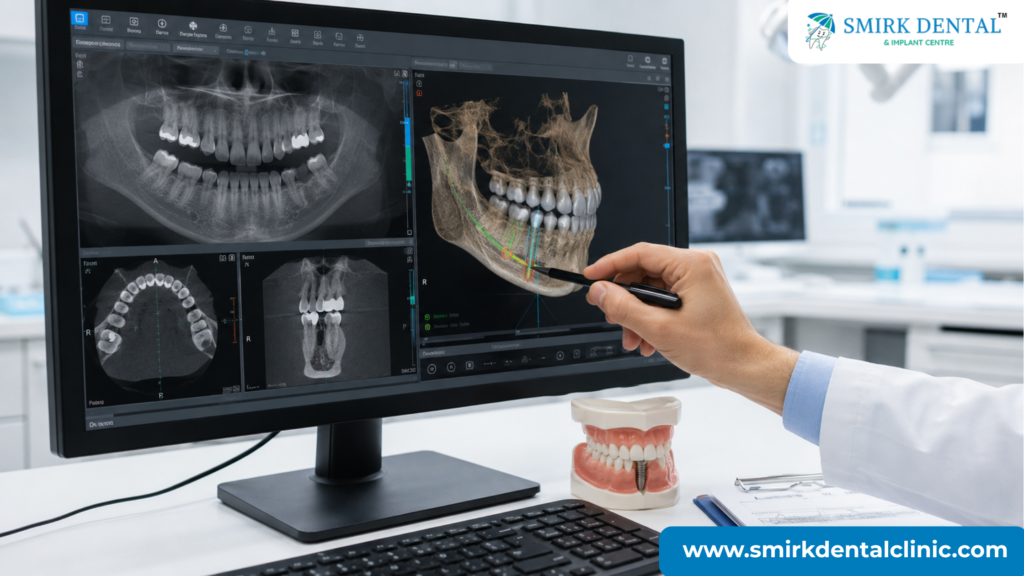
Immediate loading with Swiss Strategic Implants works well even for patients with inadequate bone density, provided general oral health supports it – confirmed through an OPG and CBCT scan before any treatment decision is made. Patients who’d need significant bone grafting for a conventional implant may still be excellent candidates for this technique specifically, because it’s built to anchor in bone that wouldn’t support a traditional implant. Smokers and patients with uncontrolled diabetes are still assessed individually, since healing risk factors matter regardless of anchoring technique – and Dr. Gupta will say plainly if a case doesn’t suit the timeline rather than push it. That kind of honesty is, frankly, rarer in implant dentistry than it should be.
Frequently Asked Questions
No – Day 1 is for implant placement and precise measurement, Day 2 includes a trial fitting to confirm bite and fit, and the final, permanent prosthesis is fitted and delivered on Day 3, once everything is confirmed.
Not typically. Placement uses a minimally invasive pin-hole technique with fewer post-operative complications than traditional flap surgery, and most patients describe the discomfort as even milder than a routine tooth extraction.
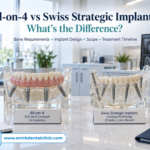
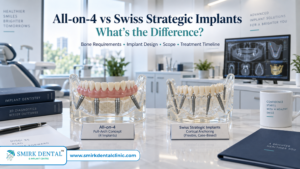
All-on-4 is a specific full-arch technique using four implants to support a complete denture. Swiss Strategic Implants with immediate loading is a broader protocol that can apply to a single tooth, several teeth, or a full arch, depending on what the case needs – the number of implants and the plan is decided per patient, not fixed at four.
Age alone rarely rules a patient out. Bone density and general health matter far more than the number on a birth certificate – Smirk Dental has treated implant patients well into their seventies and eighties with good outcomes.
Ready to find out if you’re a candidate? Book a free implant consultation on WhatsApp, call +91 82870 64954, or fill out the form.